An almost perfect day. I taught a yoga class early this morning on line and then did a weight training class focusing on my arms with just enough sweating anguish to have me exhausted by the end. I am so grateful for my yoga practice that combines movement, shapes, breath, and suspension of my worries for an hour or so. And I am grateful for my strength training with dancer, yoga teacher, weight trainer Katherine DeBoda since August 2024 that has enhanced my physical well-being and my functional movement. It is a wonderful companion to yoga asanas. Like a canoe and a paddle. Each propels me forward.
Continue reading “A Near Perfect Day”Yoga’s Autumnal Equinox
Make Friends With Aloneness
In the deep fall
don’t you imagine the leaves think how
comfortable it will be to touch
the earth instead of the
nothingness of air and the endless
freshets of wind? ...
– Mary Oliver (1935-2019) "Song For Autumn"
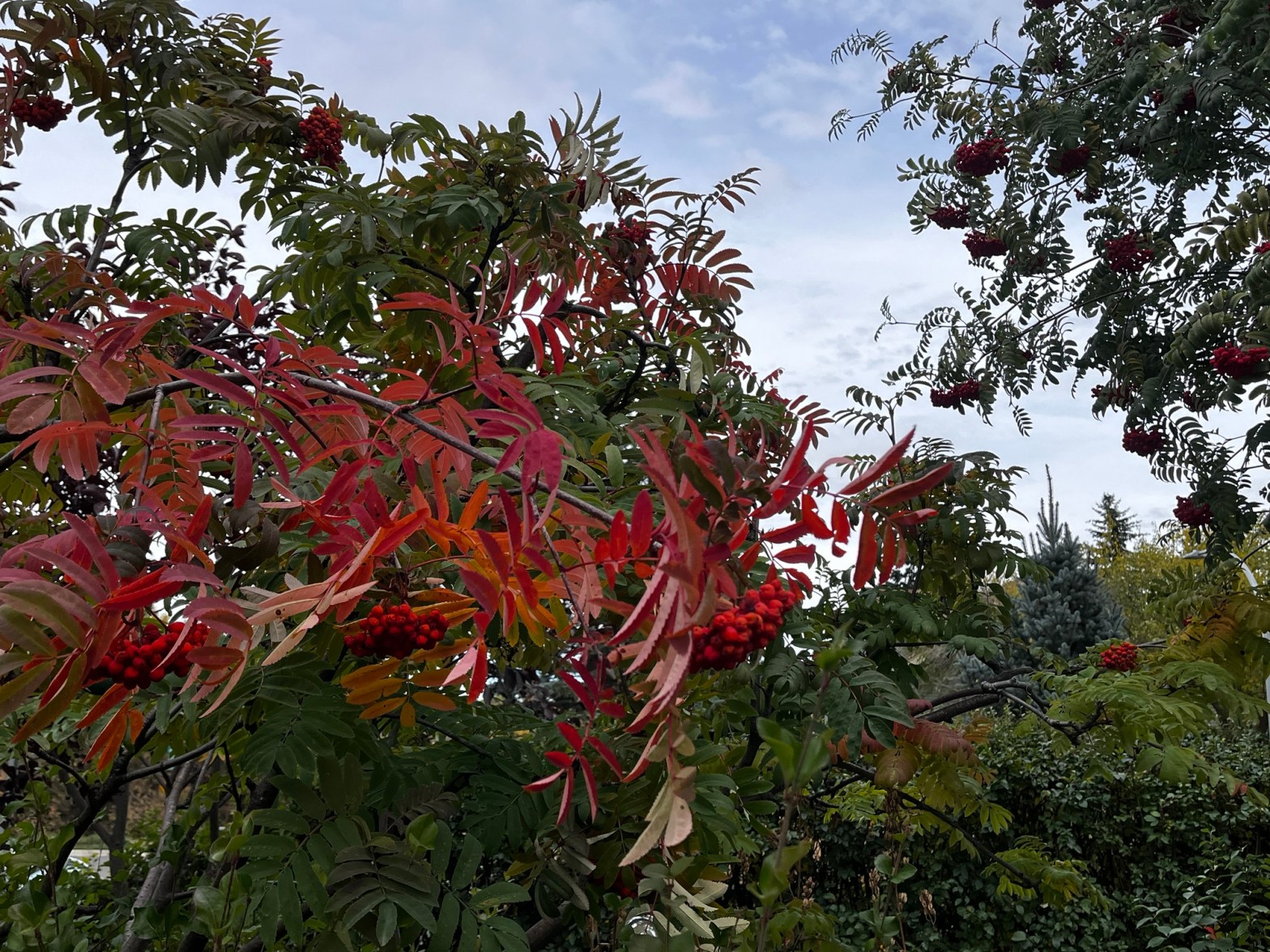
23 September, 2025: Our summer and fall have been especially beautiful in the capital city of Edmonton, Alberta. Summer days are warm or cool – not sweltering as they have been elsewhere.This September, the days are balmy. The garden blooms in late-summer nearing autumnal madness. The nights grow cooler reminding us of change. And today, the autumnal equinox announces our mid-point. A time of reassessment for some. A moment to rebalance for others. In the Chinese zodiac system, this season is associated with the metal element. We move from the active aspect yang to the more passive yin. Leaves wither and die. The landscape moves from the gorgeous vivaciousness of full-blown foliage’s green to a soothing monochromatic earthy palette.
Continue reading “Yoga’s Autumnal Equinox”I am so grateful to teach yoga into my seventies. It fills me with joy.
A New Class
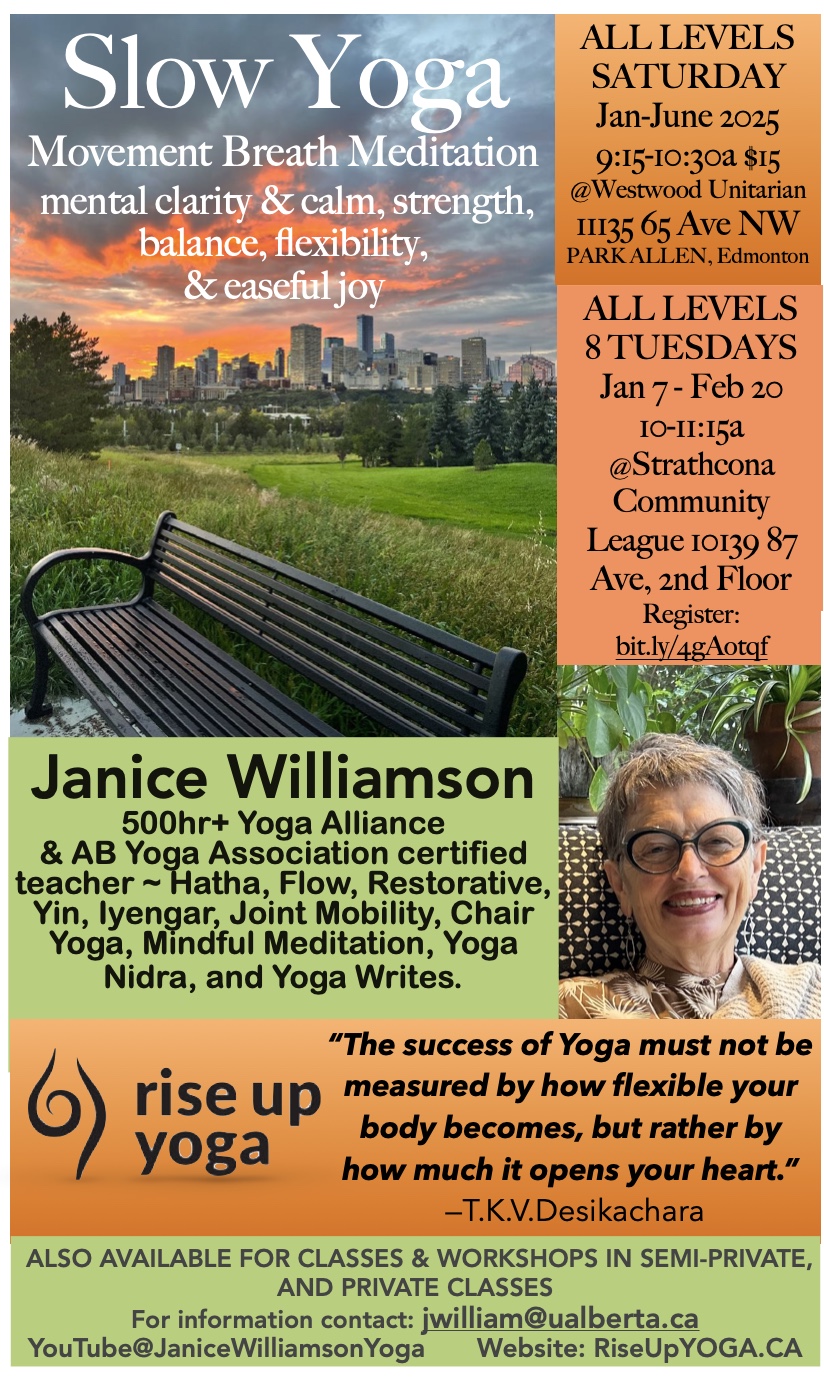
I have a new class beginning in January at the Strathcona Community League Tuesdays from 10-11:15am MST for 8 weeks from Jan 7 – Feb 20. Register here.
My ongoing Saturday morning class 9:15-10:30 at the Westwood Unitarian Congregation is attended by a wonderful group of students. Join us any Saturday at 11135 65 Avenue in Park Allen.
What is my “Slow Yoga”?
In Slow Yoga’s accessible classes, our theme is “only connect.” We listen to the intelligence of our body, our limits and possibilities. No perfect poses, only a deepening awareness and focus. To mesh mind and body, we integrate poetry and yoga philosophy into our meditation and movement. In grounding ourselves, we enhance balance and steadiness. In holding the pose, we uncover stillness and strength. In working towards our edge, we cultivate resilience. Through joint mobility gestures, we ease our pain. In letting go “like a leaf” we surrender ourselves to the present — the here and now. Invite yoga’s joy into your life. Remind your senses of everyday pleasures.
My Yoga Classes
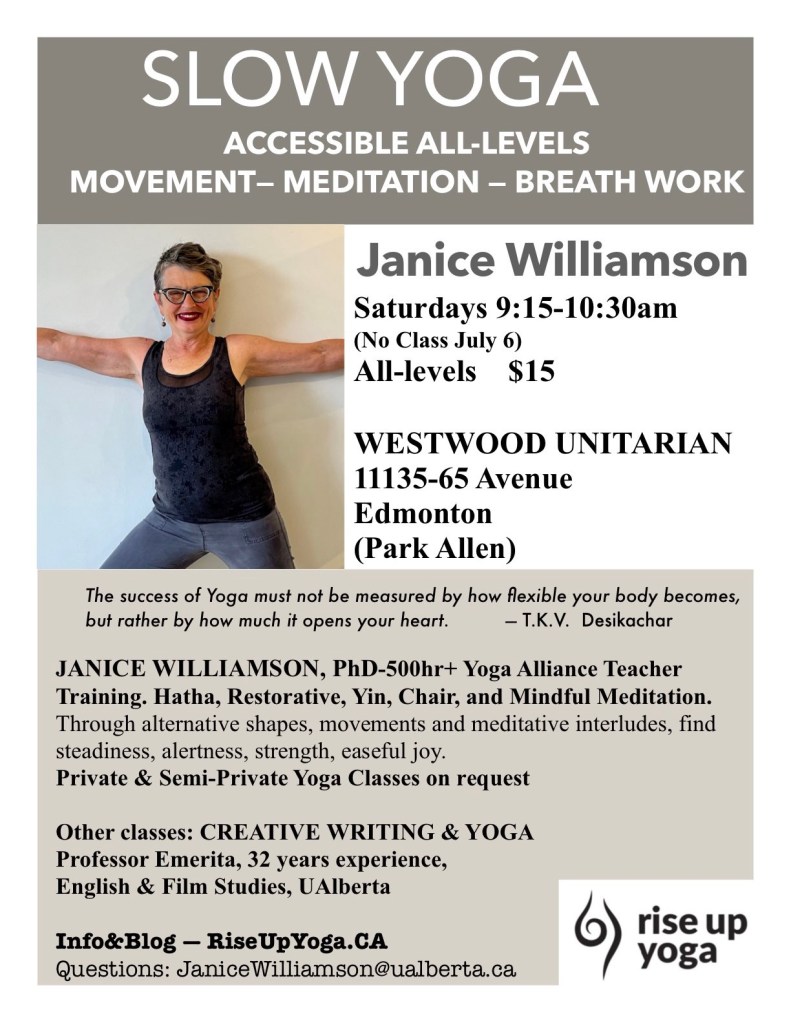
I teach yoga on Saturday mornings in Park Allen in the lovely sanctuary of the Westwood Unitarian Congregation. I am interested in potentially teaching several other classes here. If you are interested in a yoga class during the weekdays or on a weekday after work, let me know.
I am prepared to teach Hatha Yoga, Yin Yoga (holding the pose for time), “Slow Yoga”, and Chair Yoga. My training is varied and I especially like to be precise in my instruction. I am an encouraging teacher and – with the permission of students – I provide careful adjustments – one of the benefits of attending a live class.
I also teach yoga classes via zoom.
If you are interested, please get in touch.
Holding the Pose – Yin Yoga & meditation

“The practice of Yin Yoga is the cultivation of resilience.”
Pat Harada Linfoot
Body Like a River – a spine tingling Yin Yoga class
Studying Yin Yoga in my classes with Pat Harada Linfoot at her new on-line Studio Be is such a treat. Pat, one of the founders of the Octopus Holistic Yoga Centre in Toronto has, with other teachers, transformed the bricks and mortar location into a digital studio. In our Yin Yoga and Meditation class the other day our bodies moved through a regime of spine-tingling poses.
“‘Resilience’ is what we learn in Yin,” says Pat. The poses are held for from one to five minutes and this is not relaxing. (Relaxation is key to our Restorative Yoga practice which allows for long poses supported by props like bolsters and blankets and cushions etc.)
Sutra 1.1: Yoga Is Now
Yin Yoga practitioner Bernie Clark notes: “It is during Yin Yoga that we get to practice this advanced level of paying attention to our life. When we are at our edge and feeling the juiciness of the pose, we are simulating a challenging time. Now we get to notice our habitual pattern of reaction, and if it is not skillful, work to change that reaction, to create a new pattern. (The Complete Guide to Yin Yoga: Theory and Practice, 305.)
Spine Tingling

The popular colloquial expressions that we know about the spine often revolve around resolve and stiffening up. Practice rigidity says the “stiff upper lip” “find your backbone” popular idiom.
Ironically, this is what we do when we are aging in place with little flexibility as opposed to turning the clock backwards through a spine-tingling yoga practice. In yoga we seek exactly the opposite – the spine’s mobility.
One yogi notes that chronological age defines one measurement of “old”. And spinal mobility defines another.
Finding that your spine can move in six directions helps you get up in the morning. It also helps you discover courage and resolve.
Holding the Pose

Today I taught a Yin Yoga class focusing on “obstacles” (see YouTube embedded below). I grounded the practice in a few asanas, yoga sutras, pranayama, and meditation. The class is intended to initiate a healing process that begins in sitting with discomfort and difficulties. This hour-long interlude of movement and stasis allows us to identify, acknowledge, and work through obstacles.
“Holding the pose” is demanding. Today we focus on just a few Yin Yoga poses. Yin nourishes our ability to manage challenges in a productive way. Yin invites you to sit through discomfort, settle into the pose, feel the edge of your stamina, and plumb the depths of your endurance.
Sarah Powers describes “the three principles of a Yin practice. First, come into the pose to your appropriate edge, allowing stimulating sensations to be present without feeling overwhelmed or alarmed. Second, become still, muscularly unengaged but stretched, and mentally willing to surrender to the experience. Third, hold the pose for a while. I recommend 3 to 5 minutes to start, but if one minute is enough for you, start with that; in a month or so work up to 2 minutes” (Insight Yoga, 39).
This class focuses on the liver & gall & kidney & spleen & bladder meridians. Commentary on meridians below is from Sarah Powers book Insight Yoga.
- Shoelace Pose stimulates the groin and Liver meridians while calling to the Gallbladder meridian in the outer hip and leg.
- Sphinx Pose stimulates the Kidney meridian along the sacrolumbar area and the lumbar spine. “Passive backbends stimulate kidney chi revitalizing your energy supply.”
- Dragonfly Pose and Lateral Dragonfly Pose “stimulates the Spleen meridian as it flows up the inner thighs.”
- Sleeping Swan Pose “stimulates the Spleen meridian — the groin of the frontl eg and along the inner thigh of the back leg.”
- Corpse Pose/Savasana flushes out mental distractions and restores energy.
- Butterfly Pose stimulates “the Kidney meridian as it flows along the inner legs and through the torso.”
“Overcoming Obstacles — YIN YOGA Asanas with Meditation
ThIS Yin Yoga Sequence:
0:00 Pranayama
2:55 Cow Face Pose or Shoelace in Yin Yoga (meditation: T.K.V. Desikachar commentary on “obstacles”)
9:28 Cow Face Pose or Shoelace in Yin Yoga [other side] (meditation: focus on the senses to overcome obstacles)
12:34 Dandansan/Staff Pose (tapping our body)
15:25 Upavistha Konasana/Wide-Angled Seated Forward Bend or Dragonfly AND LEFT SIDE: Parsva Upavistha Konasana / Revolved Seated Wide-Angle Pose or Lateral Dragonfly in Yin Yoga with neck extending movements
21:37 Baddha Konasana/Cobbler Pose or Butterfly in Yin Yoga (with pranayama)
25:30 RIGHT SIDE: Parsva Upavistha Konasana/Revolved Seated Wide-Angle Pose or Lateral Dragonfly in Yin Yoga
31:14 Pigeon Pose/Kapotasana or Swan and Sleeping Swan in Yin Yoga with “Mind Like the Sky” meditation
39:55 Salamba Bhujangasana/Sphinx Pose
44:20 Thunderbolt Pose variation on toes/Vajrasana or Toe Squat in Yin Yoga with shoulder/arm stretches
47:03 Marjaryasana – Bitilasana/Cat – Cow variations
49:12 Supported Bridge and meditation on writing obstacles
51:58 Savasana / Final Relaxation variations
58:10 Reading on “overcoming obstacles” via Sutra 1.32 & 1.32
What inhibits or helps to maintain our yoga practice
Are you a yogi? A writer? A mother? All of the above? Or none. What is it that inhibits you from attending to what matters in your lives?
How do we define the distractions and obstacles we encounter? The ancient yoga sutras offer a refined list of obstacles. Is this an exhaustive list or are there other unnamed obstacles that you encounter?
D.K.V. Desikachar writes on how to overcome obstacles and distractions in his The Heart of Yoga: Developing a Personal Practice. (All translations and quotes are from pp126-7 & 158-9.)
“There are nine types of interruptions to developing mental clarity: illness, mental stagnation, doubts, lack of foresight, fatigue, overindulgence, illusions about one’s true state of mind, lack of perseverance, and regression. They are obstacles because they create mental disturbances and encourage distractions.”
Patanjali’s Yoga Sutra 1.30
- ILLNESS or ‘Vyadhi’ — “I must do something to improve my health before I can go on.”
- MENTAL STAGNATION or “Styana” — heaviness/lethargy caused by eating too much, eating badly, enduring cold weather, or simply by the nature of your mind’s mood.
- DOUBT or “Samsaya” — “a regular and persistent feeling of uncertainty.”
- LACK OF FORESIGHT or “Pramada” — in acting carelesslessly or hastily “we slip back rather than make progress.”
- FATIGUE or “Alasya” — Resignation or lack of enthusiasm and motivation is a serious obstacle.
- OVERINDULGENCE or “Avirati”: — Distraction or “when our senses gain the upper hand and begin to see themselves as masters rather than servants of the mind.”
- ILLUSIONS ABOUT ONE”S TRUE STATE OF MIND: Ignorance & arrogance or “Bhrantidarsana” — When “the feeling of having reached the top rung on the ladder is only an illusion.”
- LACK OF PERSEVERANCE: Disheartened paralysis or “Alabdhabhumikatva” — becoming disheartened and paralyzed when “we suddenly notice how much there still is for us to do.”
- REGRESSION: Lack of confidence or “Anavasthitatvani” — When “you may have reached a point you have never reached before, but you lack the power to stay there and fall back, losing what you have gained.”
In the final relaxation/savasana sequence in this Yin Yoga class, I read from Pantanjali’s Sutras on overcoming obstacles and distractions:
Sutra 1.32 “If one can select an appropriate means to seady the mind and practice this, whatever the provocations, the interruptions cannot take root.”
Sutra 1.33 “In daily life we see people around who are happier than we are, people who are less happy. Some may be doing praiseworthy things and others causing problems. Whatever may be our usual attitutde toward such peole and their actions, if we can be pleased with others who are happier than ourselves, compassionate toward those who are unhappy, joyful with those doing praiseworthy things, and remain undisturbed by the errors of others, our mind will be very tranquil.”
My Yoga – Towards Hanumasana ( Monkey Pose)

“Be soft in your practice. Think of the method as a fine silvery stream, not a raging waterfall. Follow the stream, have faith in its course. It will go on its own way, meandering here, trickling there. It will find the grooves, the cracks, the crevices. Just follow it. Never let it out of your sight. It will take you.
Taiwanese Buddhist monk
Sheng Yen (1931-2009)

The Hanumanasana Posture Has Roots in the Hindu Myth of the Monkey God Hanuman
The yoga posture Hanumanasana (known to child gymnasts as “the splits”) is named after Hanuman, the Monkey God, (around 5000 BC) rumoured to have leapt from India to Sri Lanka – thus the grand leap of “the splits.”
In Light on Yoga, BKS Iyengar recounts the Ramayana myth of Hanuman, “the powerful monkey chief of extraordinary strength and prowess.” An excerpt from this story outlines this scene.
“During the battle [in Sri Lanka], Laksmana had been struck by an arrow and lay unconscious and it was Sid that the only cure was the juice of a herb which grew in the Himalayas. With one prodigious leap Hanuman crossed the sea and reached the Himalayas to bring back with him the mountain top on which the life-giving plant grew and thus saved the life of Laksmana.”
Thus the Hindu god Hanuman is associated with compassion and the Heart Chakra as well as Prana or energy.
The Process of Yoga Requires Both Abhyasa (discipline) & Vairagya (letting go)
Vairagya is to not allow our past action patterns, addictions, or strong desires to affect our focus. Diligent practice (abhyasa) directed inward will, over time, cultivate vairagya.
Nicolai Bachman, The Path of the Yoga Sutras (34)
While working on these postures, I keep in mind several yoga principles that are sometimes thought of as “two wings of a bird.” The class takes up two complementary notions: Abhyasa and Vairagya.
ABHYASA

- focused attention
- diligent focused practice
- effort
- willpower

"Abhyasa use or practice is the effort to fix one's own self in a given attitude. …Both practice (Abhyasa) and non-reaction (Vairagya) are required to still the patterning of consciousness.”

—- Translation of Patanjali’s Sutra 1:13 by Swami Krishnananda (1922-2001)
VAIRAGYA

- letting go
- "nonattachment to sensory objects
- indifference

“The secret of happiness lies in the mind's release from worldly ties.”

—- The Buddha
My Yoga Class — “Towards Hanumanasana”
Above is a video of my student teacher class I created as part of my Octopus Garden Yoga 300-hour Advanced Yoga Teacher Training.
The postures are part of my apprenticeship to the Hanumanasana pose – a focus on the journey towards the posture, rather than the posture itself.
I am grateful to my teachers Jennifer Helland, Darcie Ladd, and Pat Harada Linfoot at Octopus Garden who developed sequences and insight into this posture. (My videotaped class has many imperfections that are my own. )
The Postures Towards Hanumanasana
What does our body and our mind need to know/feel/experience/understand to open itself up to this demanding posture? The last time I performed the splits, I was approximately eight years old. Now that I’m almost 72, the posture eludes me but I know the preparatory poses will be of benefit.
There are a number of physical abilities we need to extend and develop in order to perform Hanumanasana. These include work on the hip flexors, the hamstrings, as well as developing the internal rotation of the hips and a sense of balance in the pelvis.
Below are some of the preparatory postures that will open your body towards Hanumanasana.
Variations on Mountain Pose: You might work on hip rotation and stand in Mountain Pose rotating your toes outward and back again while keeping your heels together (ie moving into what in ballet is “second position.”)
High Lunge to Warrior 2: You could stand with your back leg facing forward in an High Lunge position and then turn your back foot out into Warrior 2 position. This movement requires you to rotate from the hip.
Using Props to slowly drop into Hanumanasana: You can use props to develop the pose. Lay a bolster horizontally across the mat directly underneath your pelvis. Add blocks or more bolster support if necessary. Extend one leg in front and another in back. Place hands on either side of the bolster on the floor or on blocks if required. Lift torso up without compressing your lower back.
Or you could follow along with some of the postures in my YouTube Hanumanasana class above. The class is organized as follows:
0:00 Introduction to Hanumanasana Pose and to the Yogic principles of “Abhyasa” & “Vairagya”
4:30 Supta Pandangusthasana A & B (Reclining Hand-to-Big-Toe Pose)
15:14 Upavista Konasana (Wide angle seated forward bend)
18:50 Buddha Konasana (Butterfly/Bound Angle Pose)
19:30 Tadasana (Mountain Pose)
20:49 Surya Namaskar (Sun Salutation A)
29:18 Chakravakasana (Cat/Cow)
30:38 Anjaneyasana (Low Lunge) to Ardha Hanumanasana (Half Monkey Pose)
32:30 Utahan Pristhasana (LIzard Pose)
33:29 Eka Pada Rajakapotasana (Pigeon Pose)
38:13 Adho Mukha Svanasana (Downward Dog) Variations
40:21 Uttanasana (Forward Fold)
42:30 Parsvottanasana (Pyramid)
46:51 Virabhadrasana II (Warrior 2)
47:59 Trikonasana (Triangle) & Privrtta Trikonasana (Revolved Triangle)
51:50 Setu Bandha Sarvangasana (Bridge)
57:75 Ananda Balasana (Happy Baby Pose)
57:20 Supine Twists including Thread the Needle
59:58 Savasana (Corpse Pose)
These videos are my student/teacher videos. They are works in progress. Constructive criticism is appreciated. Thank you.
The Beauty of Yoga
We came full circle.
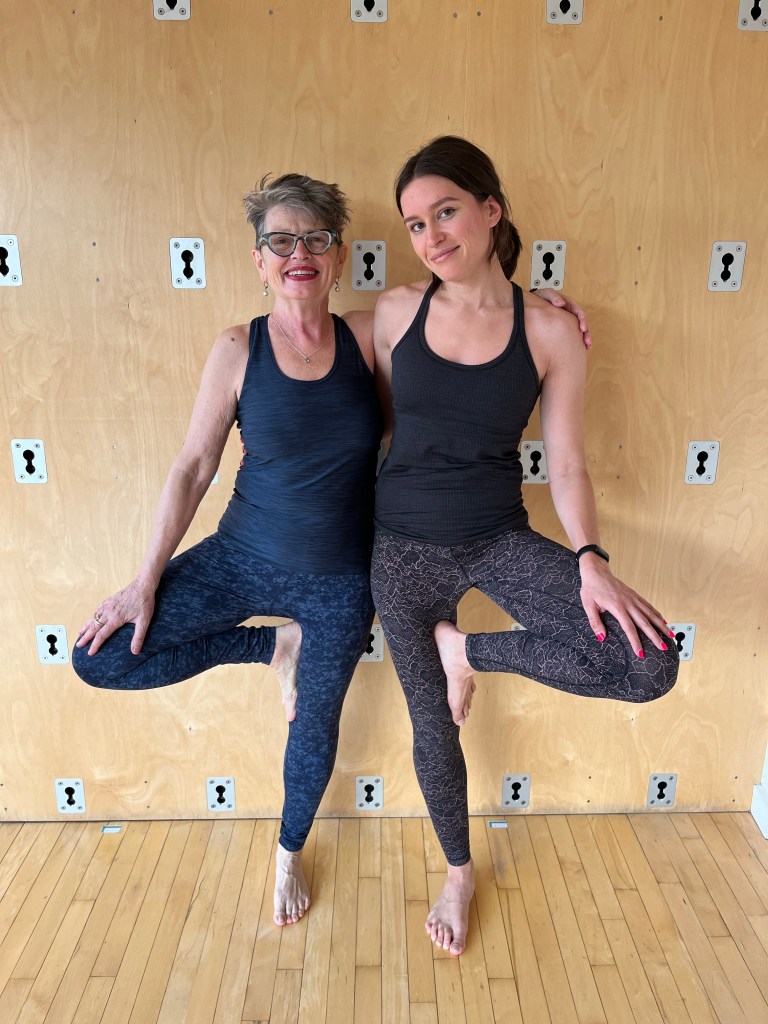
In about 1981, I introduced yoga to Kim Echlin, a fellow PhD student, now accomplished writer of many novels and other works. Kim remains my dear lifelong friend. The late inspiring Esther Myers was our yoga teacher then. In 1987, I would move away from Toronto while Kim would go on to become a CBC cultural journalist and make a short film about Esther.
Over the years, our long friendship evolved into a weekly facetime chat during COVID. In January of 2021, Kim remarked that I sounded a bit depressed. I listened affirmatively as she told me her storefront yoga studio in the Beaches neighbourhood of Toronto had transformed into a zoom studio. So this time around, Kim drew me back into my yoga practice and a lovely new yoga community. There I found wonderful teachers including Iyengar teacher Cindy Campbell and flow yoga teachers Lana Sugarman and Angela Yazbek. And a group of convivial fellow students.
By the fall of 2021, I had been diagnosed with Giant Cell Arteritis and a year-long regime of medication including high doses of steroids and an expensive biologic. The counter-effects of the drugs were quite extreme and there was a potential for bone loss and diabetes and other serious developments. Leaning into the struggle, I decided to embark on a teacher training to intensify my practice (and save my bones!) My teachers guided me to Octopus Garden Holistic Yoga Centre where I completed my 200-hour yoga training from October 2021 to February 2022. In April I completed a 50 hour restorative class and in January 2023, I enrolled in my six-month 300-hour advanced teacher training there.
A few weeks ago, two years after the previous test, another bone density low-dose x-ray bone density test showed that there is no further deterioration of the bone in my hip and I have gained 5% bone density in my lumbar spine. A very good outcome! That is the inside story of my bony matter.
The rest of the story is just as uplifting. I have loved so much of this training. It reminds me of the excitement I felt during my PhD work in the 1990s. Or the thrill of my adoption in 1999 and the complex, demanding, sustaining and beautiful process of mothering my splendid daughter over the years. I am reminded of the joy of once upon a time taking a three-week intensive clowning course with clown/mask/drama teacher Jan Henderson where the days of work and play led to the full-scale manifestation of an alter-ego, another persona or two layered on top of the familiar.
With the yoga training, I feel myself into new ways of being, my body becoming stronger, my meditation knowledge stretching and strengthening. My sense of what matters shifts with philosophical teachings that emphasize the pleasures of discipline and focus along with the necessity of letting go and redirecting your energy. Some preoccupations sift away, there is a deepening of my commitment to my loving relations and friendships and care, a commitment to healthier eating, better sleeping (when possible), the habitual orchestration of an every-other-day walk with friends. All of this makes possible a reframing of my anxieties about contemporary separatist politics in Alberta with the conspiracy theorist quacks and dangerous racist anti-feminist homophobes and the equivalent itching for power with the federal CONs. The arrows of disgust and anguish no longer pointed at my own heart and head become more practically oriented towards campaigning for NDP candidates. A boundary between the inner and outer world comes into view.
Preparing the Class
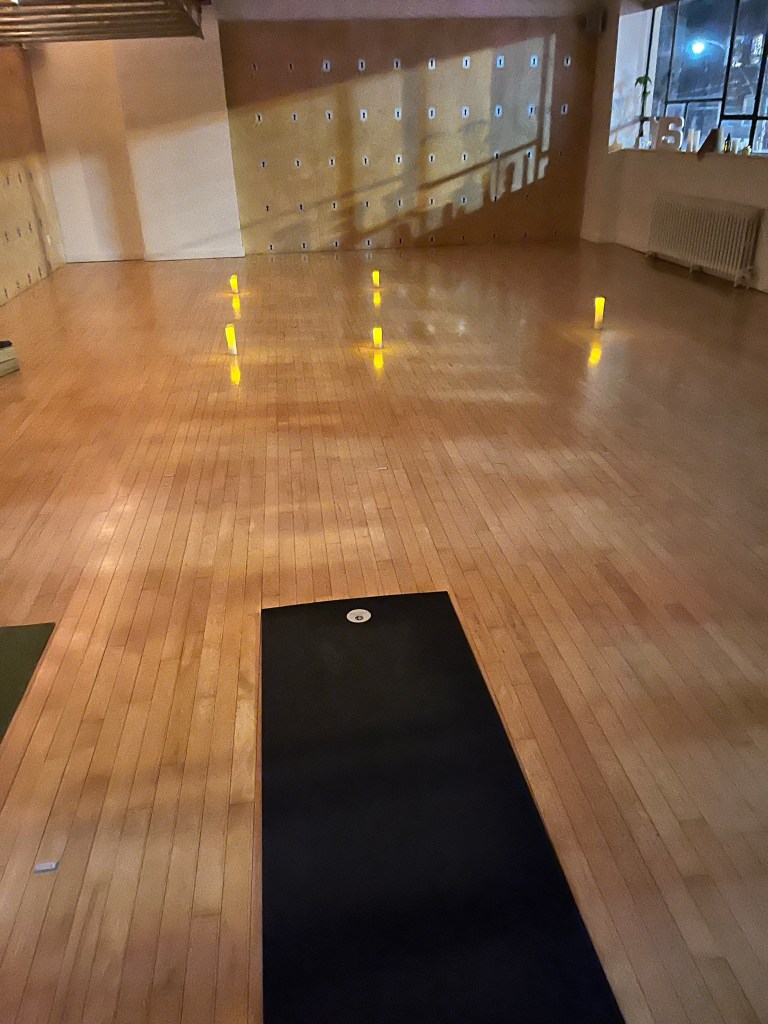
Thirty minutes of yoga. The theme is spring equinox. The spiralling return of things with the difference time makes. The echo that sounds from one year to the next, familiar and yet leaping forward as though remade anew. The spiral of the spine, the arms and upper torso reaching up, the feet, legs, pelvis grounding. A turning, a turning. Not quite round.
The practice is your own. Your body is the limit and the extension of your practice so make it your own. Rest when you must, challenge yourself when you can. There is nothing to fail at in yoga. Only a process that moves you. Yoga practice is life long and unfolding.
(To be refined and revised.)
- 10 minutes Energizing Poses continued
- 1.0 Tadasana Mountain Pose (feel your feet on the ground, lift your toes and the arches of your feet. Your big and little toe mounds and your heel will become more grounded on the floor. Imagine your roots growing out below the floor and talking to each other like we’ve discovered that the roots of trees do. We are all in this sweet practice together 😉
- 1.1 Vrikshasana Tree Pose 1: Focus on a drishti or a focal point…. a spot on the floor in front of you or on the wall… this will help you with your balance.
- 1.2 Tree (In preparation, move a bit. First slowly swinging bent leg forward and to the side and towards the backwards). Now lift the right bent knee and position your foot on the inside of the opposite leg…anywhere along the leg from the calf to the inner thigh. Press the foot into the thigh and then in the opposite direction press the thigh towards the foot. Your neck is long and your head feels like it is lifting up. Hands can be on your hips, at your side, or draw palms together into prayer position. You can raise your hands and arms above your head if you are able. Always keep your focus on the dristi, the point of concentration that is useful in more traditional meditation. Though of course there are meditative qualities to this pose as well. Inhale and exhale…
- 1.3 Tree: Lower leg. Stand in Tadasana.
- 1.4 Repeat on the other side.
- 2.1 Virabhadrasana II Warrior 2 — take long step back into Warrior 2 from Tarascan , front foot facing front of mat, back foot on the diagonal between front and side with the knee over the toes, your torso is facing the long side of the mat.
- 2.2 Arms extend the long width of mat – feeling the oppositions in this pose, the energy moving in opposite directions in your arms, the front knee bent, the back knee straight – imagine you are hugging the knee muscles into the bone – the straight leg extending —- your thighs are externally rotating outwards moving in opposite directions.
- 2.3 You might be able to sink a little lower. Now raise your back arm up as you imagine your back leg and arm extending in a powerful two pointed diagonal heading up towards the ceiling corner of the room and the back heel corner…
- 3.1 Shanti Virabhadrasana Peaceful Warrior – inhale and exhale and now wave your front arm up and back in a gentle back end. The back arm rests gently on your leg.
- 3. 2 Repeat Warrior 2 on the opposite side.
- 3.3 Repeat Peaceful Warrior on the opposite side.
- 4. 1 Trikonasana Triangle Pose – Your feet are 3-4 feet apart. Straighten your front leg. Your front toes face the front of the mat. Your back toes are on the diagonal. your right heel and left heel should be aligned. Raise both arms to the sides lengthening in opposite directions. Reach your right arm far in front of you.
- 4.2 Hinge over the front thigh continuing to stretch your arm out while feeling your upper torso soar and your lower body ground into your feet. The hinge is at the hip, not the waist. Press the feet firmly into the floor.
- 4. 3 Lower and rest your lower hand to your shin or a block placed behind your front foot or the floor or whatever you can manage. Feel your ribs move further from your hips on both sides of your body so you are lengthening your torso while allowing your arm to reach down. The upper arm moves towards the ceiling up in the opposite direction. Feel the back flat against a wall, the thighs are rotating out in opposite directions.
- 4.4 Your head is in neutral position or you may turn it to look up, your arms gently gazing at your thumb
- 4.5 to come out press your feet into the ground, inhale to come up reaching up with your upper arm to draw you up….
- 4.6 Reverse on the opposite side.
- 5.1 Parivrtta Trikonasana Revolved Triangle Pose – [Place blocks outside the front foot.] Feel your upper body moving up, lower body moving down.
- 5.2 With arms extended out rotate your torso towards the front bending at the hip over the front straight leg. Imagine your spine turning. Remember this is not a neck bending exercise so you will want to imagine the movement is not at the top or bottom of your spine (neck or lower back) but in the middle of your thoracic spine…the bit that hinges to your ribs.
- 5.3 Reach your left arm down towards the block on the inside of your foot. Raise your right arm up. The spiral inside your spine, will be a corporeal spring equinox all of your own.
- 10 minutes Deepen your practice
- 6.1 Dandasana Staff Pose (Sit on a block and you may or may not use a strap) With a straight back, tip from the hips over your front legs. (If you like, put a strap around the arches of your feet and use this to give you a bit of tender leverage. You descend far as your back is straight…This is a very humbling pose. …. After a few moments, you can round your back, and relax as you arch over your legs.
- 7.1 Paschiomottanasana Seated Forward Bend … Press your thighs into the floor. If there is any strain in your hamstring, it should be in the middle, not up at the top of your hip or at the bottom where they join the knee. Walk your hands forward, toes pointing upward, energy moving out the heels of your feet. Your chest is facing down towards your legs…..
- Think about letting go. Find a stretch rather than a strain, and allow your body to draw closer to your legs with your exhalations…
- If you like you can separate your legs slightly to make room for your torso.
- You can also place a pillow or bolster on your lap and fold over this.
- 8.1 Seth Bandha Sarvangasana Bridge Pose Lie on your back. Knees bent. Legs hip distance. stretch your arms alongside your body. Press through your feet. Tilt your tail bone up. Your pelvis is lifting up. Lift spine bone by bone. You can feel energy moving from your knees to the wall at the front of the room. Press your arms down. You can hold onto the edges of the mat if you like or you might clasp your hands under your buttocks and stretch them towards your feet. Ground your feet. Breath in and out. Continue to press down.
- 8.2 Lower down bone by bone.
- 8.3 Repeat slowly once more.
- 10 minutes Lightening and sinking
- 9.1 Septa Kapotasana Eye of the needle or Dead Pigeon or Supine Figure 4
- 10.1 Supta Masyendrasana Supine Spinal Twist Variations
- 11.1 Sarasana Corpse Pose
During Final Relaxation, I Read An Excerpt From a Poem By Mary Nyquist
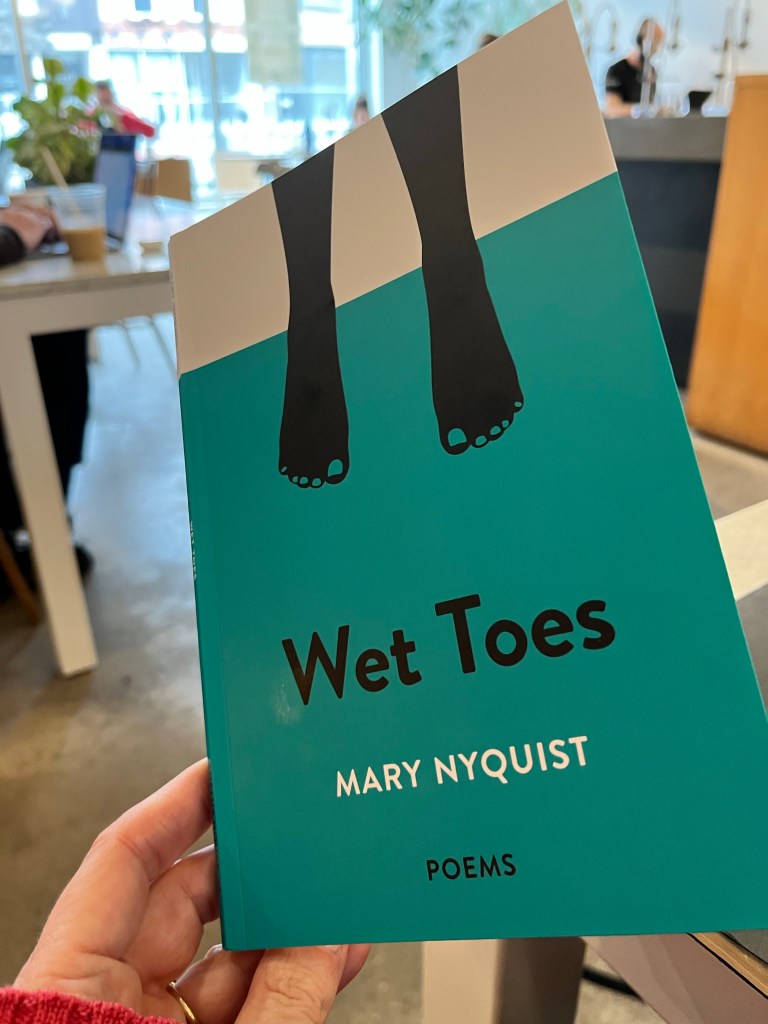
Wet Toes
Why fall
asleep
when you can let yourself
down gradually,
as you’d enter a pool.
Better, remain
amphibious, viewing
what the day projects
on the same screen as
what drifts onto sleep’s shore:
scenes from forgotten dreams,
previews of dreams never to be.
Practice seeing
in the dark,
not with cats’ eyes
shining, on the prowl,
but with eyes close-lidded
in the stillness
opening inner sight.
Prolong this
in-betweenness, this pre-
orgasmic freeness, float
suspended, buoyed up
by an element not
quite bodily, keeping
whatever lies in wait
below, in the deep, safely
at bay, hoping this little death won’t,
yet,
not yet
come
Mary Nyquist. Wet Toes. Toronto: Aoelus House (2022): 27.
Reflections on Preparing to Teach My First Class to Live Human Beings
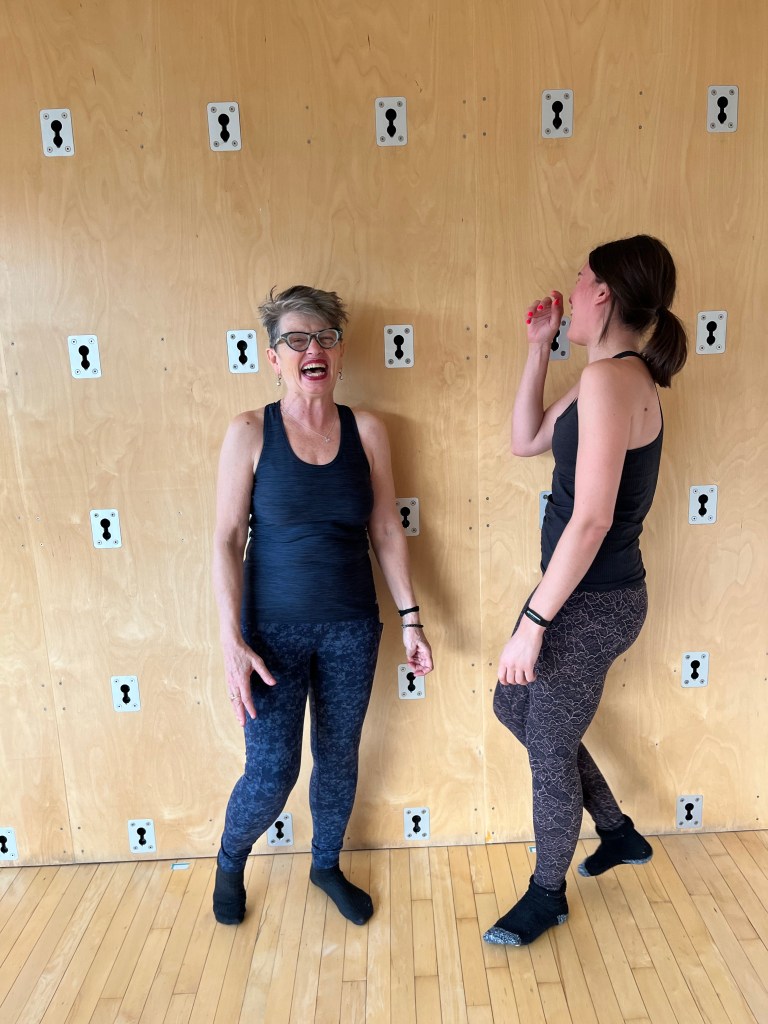
As part of my advanced yoga teacher training, my task is to take up the latter half of a yoga class. Planning it is a bit excruciating because over the course of the four-day intensive workshop, I find my skills unfurling into a confusing mess of forgetting and improvised nervousness. Or perhaps the skills were always this unpredictable and their fragility only visible in the performative moment.
When the going gets rough, I get gone. My mind blank. A brain fog of where how why when who what!…. What comes next. How do the prompts emerge from my voice while my body is moving in rhythm with the embodied knowledge of decades of familiarity with the poses.
Midway Through the Six-Month Course, Two Insights Emerge In My 300-hour Teacher Training Four-Day Retreat
Insight #1: When I was about 27, I had a premonition of my body’s late-coming illness (and possible cause of death in the future). I meditated with a meditation teacher from New York who worked with palliative care patients. My meditation was transformative and I felt my body shrinking into the interior bloodways or arteries. I was a deep sea diver within my own body floating suspended happy and serene. The meditation leader eventually called to me and I came back into the space of the temple astonished by what had transpired. Now almost fifty years later I’ve developed Giant Cell Arteritis, an auto inflammatory disease that involves enlarged blood cells clogging the arteries over your temples and potentially blinding you. The disease can also cause aortic aneurisms and strokes. Now I look back and imagine this skilled and dedicated meditation teacher took me on a journey charting my own potential death. What a trip!
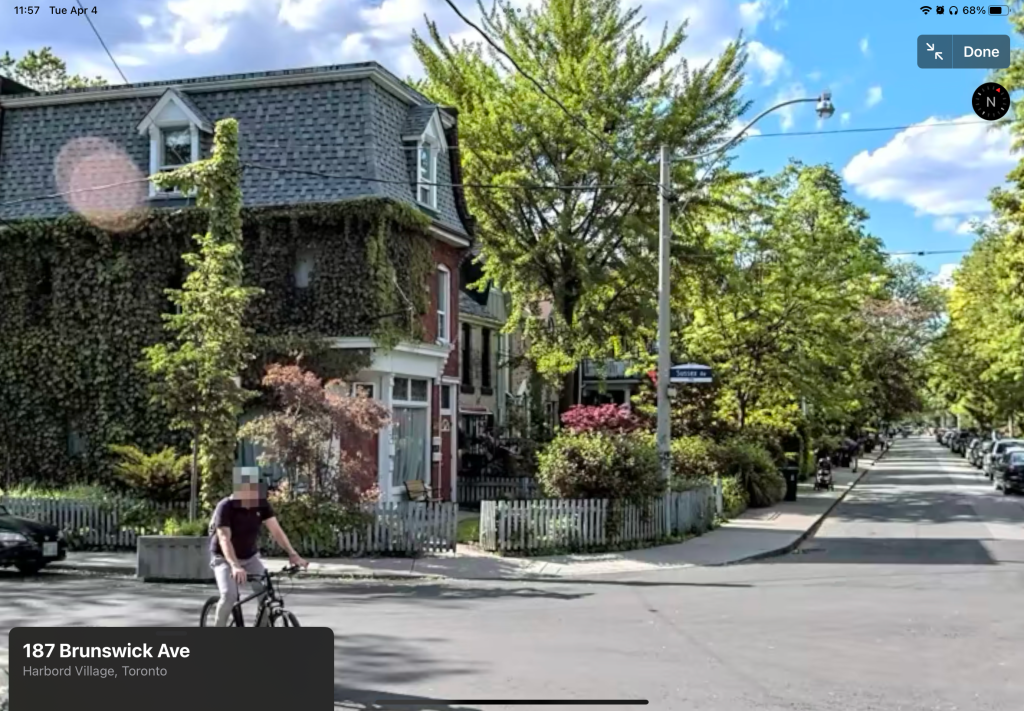
Insight #2: During the small group adjustment workshop, the generous teachings offered by Pat and Jen reminded me so very much of my early classes with Esther Meyers. In 1978 or so, we were a small group of students in her newly opened storefront studio at the corner of Brunswick and Sussex. Esther’s classes were beautiful. Six or seven intermediate students. I was about 28. The eldest student was seventy would go on to perform her yoga asanas into her 80s. I am sorry I cannot remember her name. One of the other students would eventually take over Esther’s studio after her early death. I am so grateful I was able to take up her intelligent and disciplined and fierce yoga teachings.
Both these insights draw me into the past of my youth and forward to this moment as an old(er) woman and beyond.
How do I love thee, yoga.
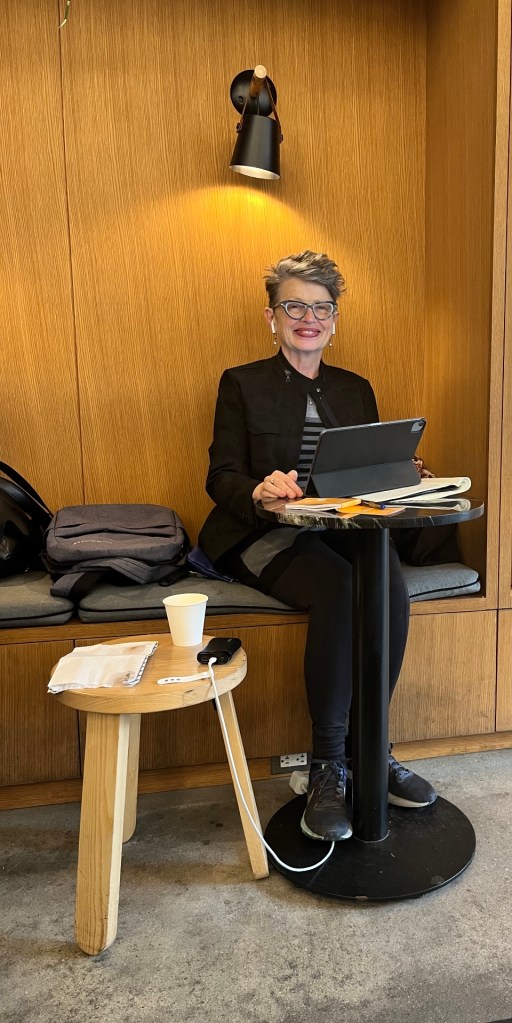
Who knew retirement was about Asteya, stealing time from the grim reaper?
I anticipating writing books, travel, solitary pleasures and doing more of what I wanted to do when I was a professor.
And so it goes.
As I have discovered over the past four years, my retirement roots into my bodily pleasures – the Eros of intimate relations with a generous lover, preparing and sharing meals with deepening friendships, and yoga’s daily practice and welcome preoccupation.
Encore!
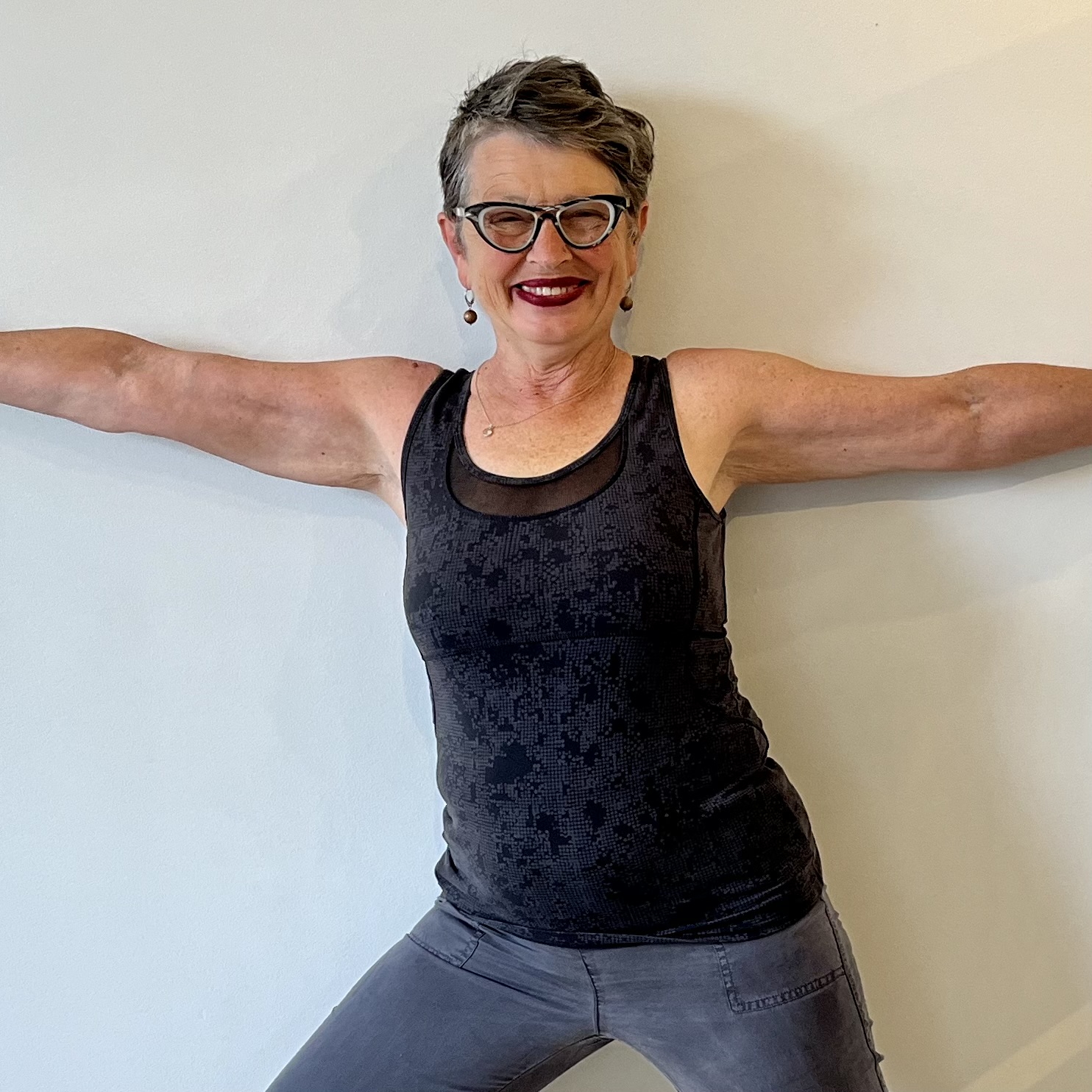
Beginning to teach yoga at 72 feels like the perfect time to reinvent myself. After my retirement from the university, I missed the contact with students and I grew more intent about sharing my yoga practice that has been so nourishing to me. I look forward to meeting new students. Get in touch with me if you would like to find out more about my work and my teaching plans.
 RiseUpYOGA.ca